
Why Traditional Stress Management Doesn’t Work for Autoimmune Disease—and What Does
I remember the beginning of my healing journey and how terrified I was of stillness. Restorative yoga felt both awful and incredible at the same time. My body resisted every quiet moment because stillness didn’t feel safe—it reminded me of being sick, stuck in a hospital bed, vulnerable and powerless.
I didn’t realize it then, but I was living in a constant hum of fight-or-flight, rushing, pushing, “busy-busy-busy,” mistaking adrenaline for energy. So when restorative yoga gave me those brief flashes of relief—tiny pockets of calm—they felt foreign, almost threatening. I later learned this wasn’t an emotional weakness. It was physiological dysregulation. My nervous system had learned that rest equals danger.
It took many sessions before my body could trust stillness again. But those early experiences taught me something essential: healing an autoimmune body doesn’t start with willpower—it starts with safety.
You’ve probably heard the advice to “manage your stress.” Maybe you meditate, you journal, you try to stay positive. And yet the flares still come, the fatigue lingers, and your body feels like it’s constantly bracing for something. What if your struggle isn’t a lack of discipline or emotional coping skills at all? What if your body is asking for something deeper?
For those of us living with autoimmune conditions, lasting stability comes not from better emotional regulation or positive thinking, but from soothing and supporting the body’s underlying physiological regulation: the hardware that sets the tone for everything else.
The Two Sides of Stress: Mind vs. Body
To move forward, we need to clearly define the two types of regulation we engage in every day:
Emotional Regulation (ER)
This is the software of your mind—your ability to manage, process, and respond to your feelings in a contextually appropriate way.
The Goal: To help your mind cope with challenging external and internal events.
Examples: Taking a deep breath before reacting to a stressful email or using cognitive reframing to see a situation differently.
Physiological Regulation (PR)
This is the hardware of your body—your nervous system’s core ability to maintain internal balance, manage sensory input, and switch smoothly between the Sympathetic (fight/flight) and Parasympathetic (rest/digest) nervous systems.
The Goal: To keep your body's alarm system—the HPA axis—in a safe and balanced state, allowing your immune system to focus on maintenance instead of defence.
Examples: How well your body processes bright lights, manages muscle tension, or handles a drop in blood sugar.
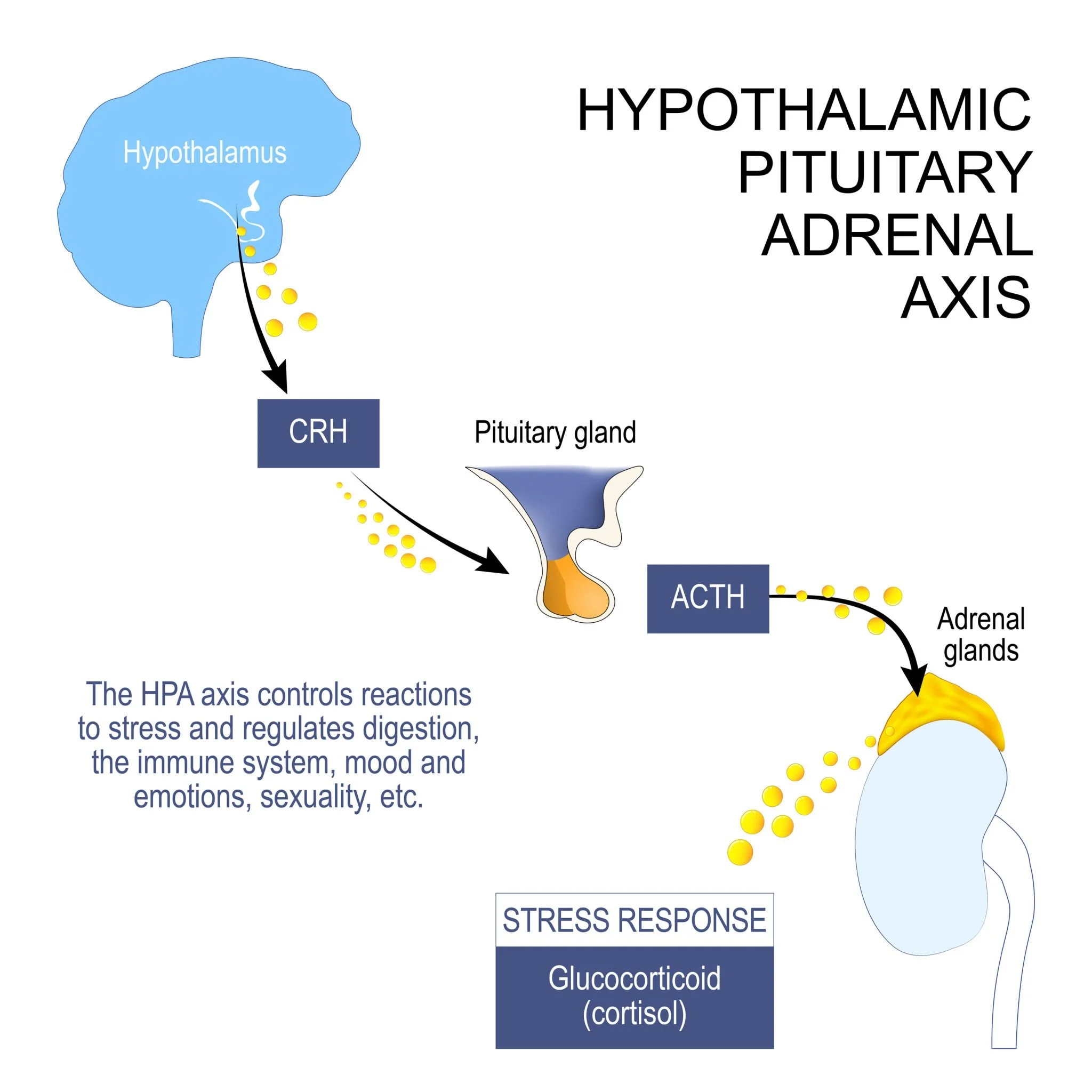
The HPA Axis (Getty Images)
The Shift in Perspective: From Self-Blame to Understanding
Autoimmune bodies often live on a very short fuse—not because we’re “too sensitive,” but because the nervous system is already overloaded long before symptoms appear. When we interpret every reaction through the Emotional Regulation lens, we end up blaming ourselves for something our physiology is driving. Shifting to a Physiological Regulation lens helps us understand what’s truly happening inside the body—and reminds us that gentleness, not judgment, is the path forward.
Here is how this essential shift in perspective works using real-life examples:
Scenario: The Traffic Jam
You get cut off in traffic and immediately slam on your brakes, followed by extreme, lingering anger. This is viewed as an emotional failure. You think, "I have poor impulse control; I need to be better at staying calm." This was actually physiological dysregulation. Your body was likely already running on four hours of sleep and skipped lunch (major PR stressors). The traffic just provided the spark. Your nervous system, already hyper-aroused, defaulted to the fight response because it had no reserve left.
Scenario: The Social Event
You attend a dinner party but feel exhausted, can't focus, and have to leave early. You feel guilty about your withdrawal. This is viewed as an emotional failure. You think, "I'm too anxious to be social; I need to work on my fear of crowds." It was actually physiological dysregulation. The cumulative sensory input—multiple voices, restaurant lighting, strong perfume—created a massive sensory overload in your nervous system. Your brain used all its energy to process the environment, leaving none for conversation. Leaving early was an act of necessary self-regulation to protect your physical health and prevent a flare.
Scenario: The Flare Trigger
You’ve been managing your autoimmune condition well, but a sudden work deadline triggers joint pain or gut symptoms that could eventually lead to a full-blown flare. This is viewed as an emotional failure. You think, "My stress level is too high; I should have worked less and been more disciplined." It was actually a Physiological Trigger. The acute stress of the deadline activated your HPA axis, flooding your system with cortisol. This hormonal cascade directly influences cytokine production, prompting an increase in systemic inflammation that initiates the flare, regardless of whether you kept an emotionally calm mindset during the process.
Your Key to Healing: Prioritizing Physiological Regulation
The takeaway is this: Stop blaming yourself for feeling overwhelmed. Your body isn't emotionally failing; it's physiologically struggling under the weight of an autoimmune condition and chronic stress.
If your immune system is overactive, your number one priority is to communicate safety to your body’s hardware. You cannot effectively use emotional regulation strategies when your body feels like it's fighting a war.
This is why we shift our focus to Physiological Regulation. We use body-based methods to calm the nervous system, which in turn cools the immune response.
Actionable Physiological Regulation Strategies to Try Today:
Vagal Nerve Toning (The Direct Reset): Your vagus nerve is the superhighway of the parasympathetic (calming) system. You can tone it by:
Gargling loudly with water until you tear up.
Humming or Chanting a steady tone for 30 seconds.
Taking short, controlled cold exposures (like splashing cold water on your face).
Sensory Shielding (Lowering the Alarm): Identify and reduce environmental input that causes overload.
Wear noise-cancelling headphones in busy places.
Use blue-light blocking glasses in the evening.
Create a "No-Input Zone"—a quiet, dimly lit space you retreat to daily for 15 minutes.
Foundation First (Creating Stability): Ensure your body has the energy to regulate.
Prioritize Sleep: Treat your bedtime as a non-negotiable medical appointment.
Steady Input: Eat small, regular, nutrient-dense meals to avoid blood sugar crashes, which are a major physiological stressor.
Find Heavy Work: Gentle, intentional movement like pushing a heavy cart or carrying a backpack.
It took me many sessions of restorative yoga to acclimate to the sensation of genuine rest, but I kept going back for more. This repeated exposure was how I began to rewire my nervous system, teaching it that stillness equals safety, not sickness.
This journey led me to become a yoga teacher, driven by the desire to spread the word that yoga isn't just for fitness—it’s a powerful tool for physiological regulation, rest, and restoration. By diving into the initial discomfort and committing to the process, I learned to manage my internal hardware. I’m still learning!
By giving your nervous system the support it truly needs, you empower your immune system to finally step down from its high-alert state, leading to less inflammation and more lasting balance.
Ready to dive deeper into truly regulating your nervous system and finding lasting calm for your autoimmune journey? Sign up for my newsletter and get notified when Autoimmune Compass launches.
