
Navigating the Survival Loop
For more than thirty years, I have lived in the reality of PTSD and Crohn’s disease. Over the last nine years, I’ve done ALL the work—the yoga, the meditation, the trauma therapy—and for a long time, I felt like I was getting worse, not better.
I remember getting back to my car after a session and just bawling. Loud, gasping, heaving sobs for no particular reason other than everything needing to get out of my body and mind. I felt ashamed of a response I was so terrified of allowing. But nine years has taught me something no one tells you: That release isn't a breakdown; it’s a breakthrough. Most people don’t realize that life doesn’t repeat because of fate—it repeats because of loops. In the journey of chronic illness and trauma, we are often caught between two very different cycles. At the center of both is INTENTION.
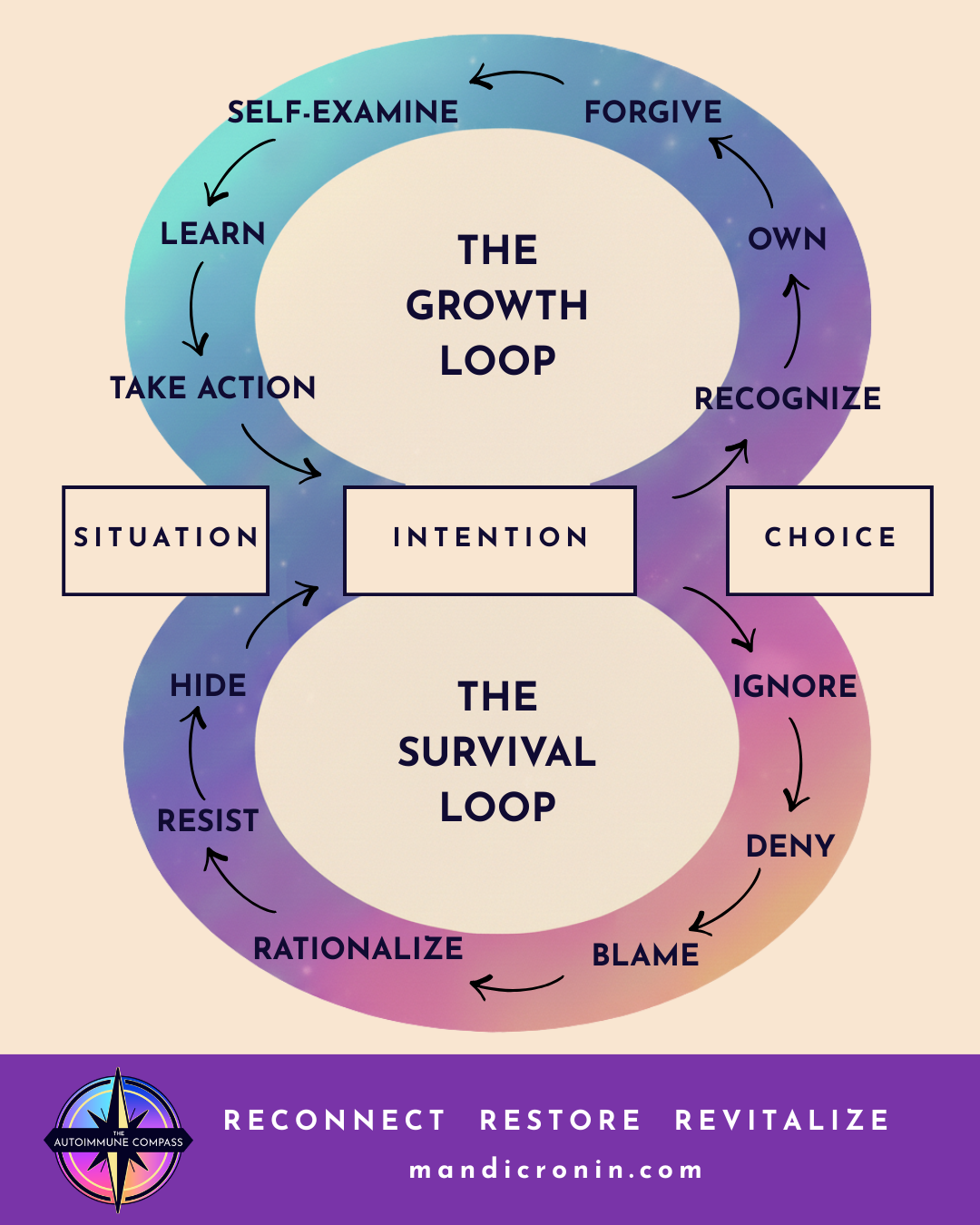
The Survival Loop (The Protective Cycle)
I used to see diagrams calling this the "Victim Loop," but I always took offence to that. I wasn’t a victim; I was in Survival. This is a physical state where the nervous system stays stuck in a defensive posture to protect you from pain. In this loop, we:
Ignore: We numb out the body's signals to "push through."
Deny: We refuse to accept that our capacity has changed, seeing it as a failure.
Blame: We get angry at the flare-ups as if our body is the enemy.
Rationalize: We stay in the perfectionist cycle, justifying the sacrifice of our health for the quest to be the best.
Resist: We fight the discomfort of stillness because we are terrified of what we might feel if we stop being busy.
Hide: We mask the exhaustion to avoid the big release.
The Survival Loop feels safe because it protects the ego, but that safety comes at the cost of stagnation. Nothing heals here.
The Growth Loop (The Somatic Path)
This is the loop of conscious growth. It’s not about being perfect; it’s about being honest. For me, this loop started in a restorative yoga class that was excruciating. While others were relaxing, I was in agony. I couldn't find comfort in the stillness. Accepting the discomfort was the path. In this loop, we:
Recognize: We notice the triggers or flare-ups without the immediate need to fix or fight them.
Own: We acknowledge our response, not the story. We realize we don't have to earn our well-being.
Forgive: We let go of the shame behind the gasping sobs and the backward steps.
Self-Examine: We look at our need to be perfect with curiosity instead of self-attack.
Learn: We practice the stillness, even when it’s uncomfortable, to hear what the body is asking for.
Take Action: We choose to surrender to what is necessary, even when it’s uncomfortable.
The Truth About the Muck
Both loops begin with the same SITUATION. The difference is CHOICE.
You don’t escape the Survival Loop by blaming less or working harder. You escape it by telling yourself the truth, even when that truth is painful. And you don’t enter the Growth Loop by being symptom-free. You enter it by being brave enough to be honest.
What I’ve learned over a decade is that you can’t mindset your way out of a survival response. My therapist was my anchor, constantly building my capacity and reminding me: You cannot rush this. You cannot push harder to heal faster.
Healing is a process of two steps forward, five steps backward, on repeat. It’s messy, uncomfortable work. You stay in the muck for a long time, feeling like you’re failing because the tears won’t stop. But then, slowly, eventually, the consistency starts to pay off. The practices stick. The way you talk to your body shifts from anger to empathy.
Choosing this path often means being misunderstood by those still in the accomplishment cycle, willing to sacrifice everything for work. But choosing growth is an act of radical self-respect.
Accountability is not punishment; it’s self-respect. Surrender is not weakness; it’s clarity. Growth doesn’t happen when life gets easier, it happens when you get braver.
Ask yourself today: Which loop am I feeding and which one is feeding me? The moment you change your INTENTION, your entire life trajectory shifts.
