
The Miracles & the Markings
When a surgeon goes into a body and makes deep tissue cuts, it is a miracle of modern medicine. But once the surgical team steps away and the skin is closed up, the medical pamphlets and post-op care guides from the hospital usually fall silent on what comes next for the tissue itself.
From a traditional hospital and surgeon perspective, the standard literature focuses heavily on clinical markers like the structural fixes, the hardware placement, wound infection protocols, and bone fusion timelines. Once the incision is visually closed and deemed medically healed, the surgical goal has been met. The medical pamphlets don't really prepare you for the intricate, living reality of the scar tissue that continues to form beneath the surface, or the psychological effects of waking up with a scar.
There is an entire world of literature out there dedicated to fascia, connective tissue, and specialized scar work, but it rarely crosses over into the standard hospital discharge packets. Anytime a surgeon makes those deep cuts, your body doesn't heal to the same way it was before. We can't expect it to operate in the same manner as it did previous to surgery. Yet, because the institutional literature stops at the surface, we are often left entirely unprepared for the deeper physical and emotional healing that has to happen alongside the structural repair.
I know this because my own life is mapped out in many, many scars. My first major one was on my forehead in junior high, after a classmate threw a baseball bat at me in anger because I struck him out. It hit me right in the middle of my forehead, leaving me with a Harry Potter scar long before Harry Potter was every written.
Because it was in a highly visible location, it did something to my mind. I was in grade nine, so there's that, but I remember genuinely believing that if I touched it, my face would just come apart, even after it was completely healed. It made me do really irrational things - I stopped washing my face because I was so sure the tissue would spilt open, blood pouring down my face. I stopped playing baseball for the same reason, even though I had never been hit in the face with the ball before. I lost my team friends because of this. I was heartbroken. I tried covering it up with bangs, but it was the late 80’s and eventually, my vanity and desire to fit in won, and my bangs were sky high, backcombed up.
Later came my abdominal scars. I have had three separate surgeries going up and down the exact same midline, creating a massive, deep scar that runs from my bikini line all the way up to just below my bra line.
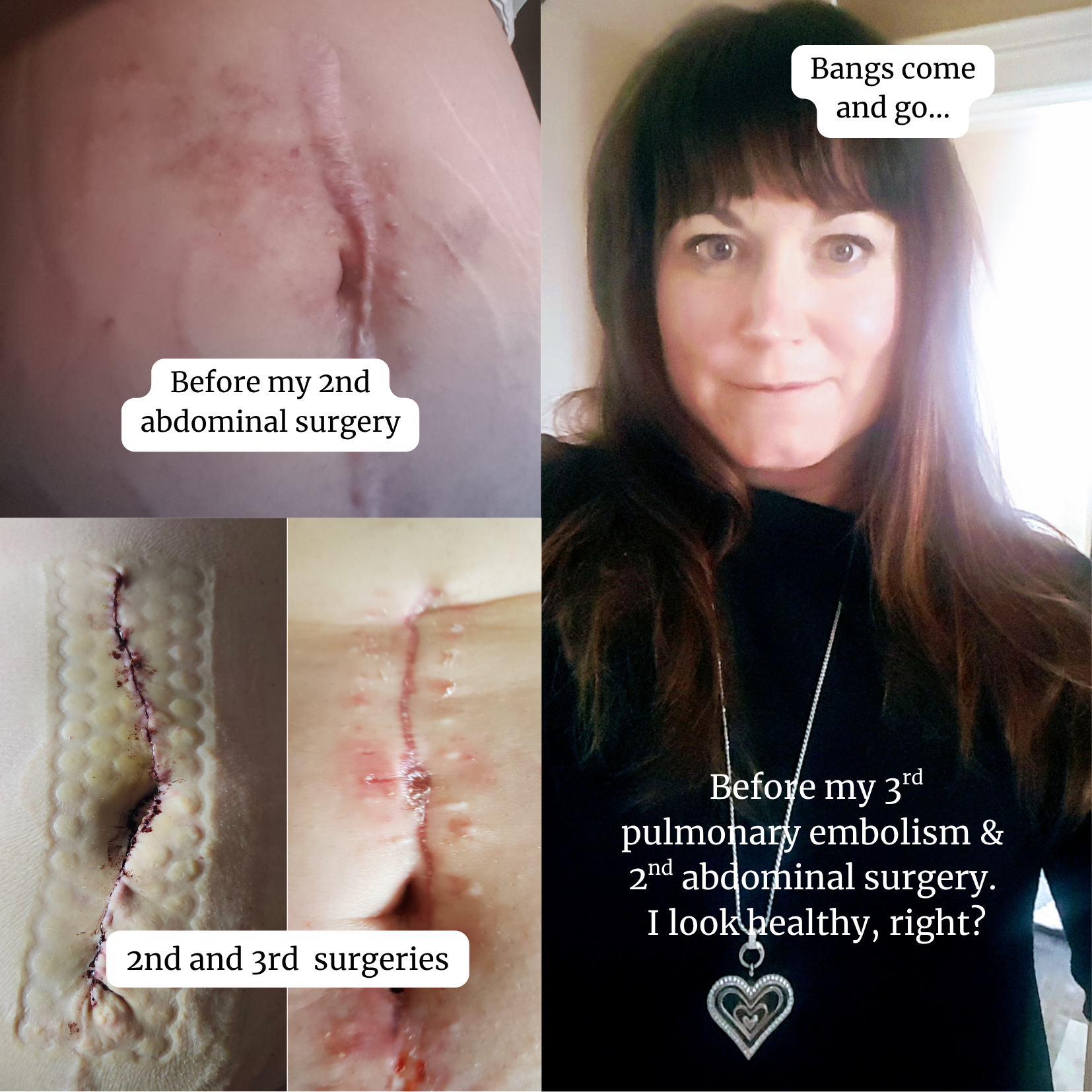
That deep tissue trauma caused a domino effect of issues I never anticipated, like pain radiating down the front of my legs, balance issues, and intense shifts in physical sensation. For the longest time, it even dictated my clothes. I had to hunt for leggings or skirts I could pull all the way up to my bra line, or dresses without waistbands, just so nothing would press against the scar. Those fashion choices weren't about style; they were somatically necessary for my well-being.
Back then, the hospital didn’t talked about scar work or how the deep fascial layers would knit together. I had to discover that entire field of literature and practice on my own, seeking out specialized practitioners who could actually help me. I learned the hard way that a scar isn't just an ugly mark on the skin, it changes how your whole body moves and feels.
What I eventually discovered is just how much targeted post-op bodywork needs to happen to actually find relief. When I was struggling with my abdomen, I found a bodyworker who could perform visceral manipulation deep inside the tissue. I didn't even know that kind of modality existed, and to be honest, it was incredibly uncomfortable. But man, did it ever bring relief.
Alongside that intensive work, regular massage therapy, gentle yoga, and somatic exercise movements became essential pieces of my recovery puzzle.
But here is the honest truth that people often resist: these aren't problems that can be completely resolved once and then forgotten. A body that has been deeply cut will be better for a little while after treatment, until it needs work again. That is going to be part of my cycle, probably for the rest of my life.
Initially, there is a lot of internal resistance to acknowledging that we need this kind of regular, ongoing maintenance. We want to be "fixed" permanently. But a deep acceptance needs to happen. Once you stop fighting the reality of your body's new rhythm, that acceptance makes everything feel a little less hard. It transitions from an annoying chore into a necessary, compassionate act of self-care.
Now, I am preparing to guide my child through their own major surgical journey. They are about to face a posterior spinal surgery that will leave an incredibly massive scar down the midline of their back.
Because of my own lived experience, I am looking at their upcoming procedure through a completely different lens than the standard hospital literature provides. My goal is to integrate what I’ve learned about the fascial system and deep tissue recovery with my anticipation of what might come up for them psychologically, helping to support them before these physical and emotional patterns set in. It takes way more work to mitigate or solve these problems down the road than it does to meet them proactively at the start.
And it’s not just the scar itself. They will have metal rods strengthening and supporting their posture, held in place by screws and pins and whatnot. There can be long-term issues with that hardware too, and as a parent, you find yourself holding a heavy mix of hope and anxiety, desperately hoping that the surgery will provide far more benefits in the long run than issues.
Because my child’s scar will be on their back, their experience will be different from mine. It won’t be constantly visible to them in the mirror, but that brings a different kind of self-consciousness. It is the vulnerability of the unseen, knowing it is there for everyone else to look at in change rooms, at the pool, or eventually, when sharing intimacy with a loving partner. Comfort being seen naked is a big deal, and at some point, I deeply hope my child is in a loving relationship and not feeling super self-conscious about their back.
Because this scar will be so much larger than anything I have experienced, and because the tissue will be healing over permanent metal anchors, the shifts in sensation will be that much more intense. The back is central to our movement, and a massive spinal scar has a huge potential to bind up tissue and alter how the body carries itself around that rigid support.
Because I know the literature on scar work and fascia now, I know we don’t have to just leave the tissue to tighten. We can actively help their body recalibrate and teach them how to embrace that maintenance cycle early on.
If I am being completely honest, I am still super self-conscious about my own scars, plural, all of them. I don't know that that feeling is ever going to fully go away. But I have come pretty close to full circle. I have learned to see my scars as symbols of my survival rather than ugly marks on my skin. I can own them now, and I can own the work that went into the healing and the suffering.
My scars are a testament to what my body has navigated. They are proof that my skin, my body, and my spirit are resilient, and that I came out of those challenges entirely capable of carrying myself forward.
That is an intense perspective shift, and it was a long time coming. I had to do a lot of internal work to get there, and I'm not naive enough to say that everyone can get there easily. It is a long, messy process.
As I stand beside my child on the cusp of their surgery, I am grateful for the wisdom written on and in my own body. Because I know the unspoken reality of the scalpel and the heavy reality of what it leaves behind, I can give my child the tools to handle the physical sensation, the space to process the emotional vulnerability, and the roadmap of acceptance and self-compassion they need to find their own strength.
Now, the issue of anesthetic and what can happen in your body….. That’s another post.
